A fire-resistant (fire-rated) sealant is an elastic compound used to seal joints, seams and small gaps in fire barriers. Unlike an ordinary sealant, when heated it keeps the joint intact and, for the rated time, holds back flame, smoke and hot gases, restoring the fire-resistance limit of a wall or floor where a solid fill cannot be made. Below we look at the sealant’s purpose, its service conditions, the rules for applying it and why regular inspection is needed.
Purpose
Fire-resistant sealant is used where utilities cross a barrier or where a structure has joints and seams:
- Sealing the gaps around cables and pipes in cable and utility penetrations.
- Joints and seams in walls and floors, and structural abutments to the barrier.
- Expansion joints — where the junction moves and elasticity is required.
Large openings and grouped penetrations are closed with a volumetric fill (compound or fire barrier block), while the joints and abutments are sealed over — in practice the solutions are combined for each specific junction.
Service conditions
Before choosing a sealant, the conditions it will work in are considered:
- Location of the junction — inside a heated space or in an unheated zone; for outdoor and damp conditions a compound with suitable resistance is selected.
- Joint movement — a static joint or an expansion joint, where elasticity and resistance to cyclic movement matter.
- Substrate material — concrete, brick, plaster, metal; it determines adhesion and whether priming is needed.
- Joint width and depth — determine the required consumption and, where needed, the use of a backer rod.
The specific compound and the required fire-resistance limit of the junction are selected in line with the project documentation of the facility.
Application
The quality of fire protection largely depends on careful installation. The general sequence of work:
- Substrate preparation. The joint surfaces are cleaned of dust, dirt, oils and loose particles; where needed they are dried and primed.
- Forming the joint. For a deep joint a backer rod is placed to set the correct geometry and fill depth.
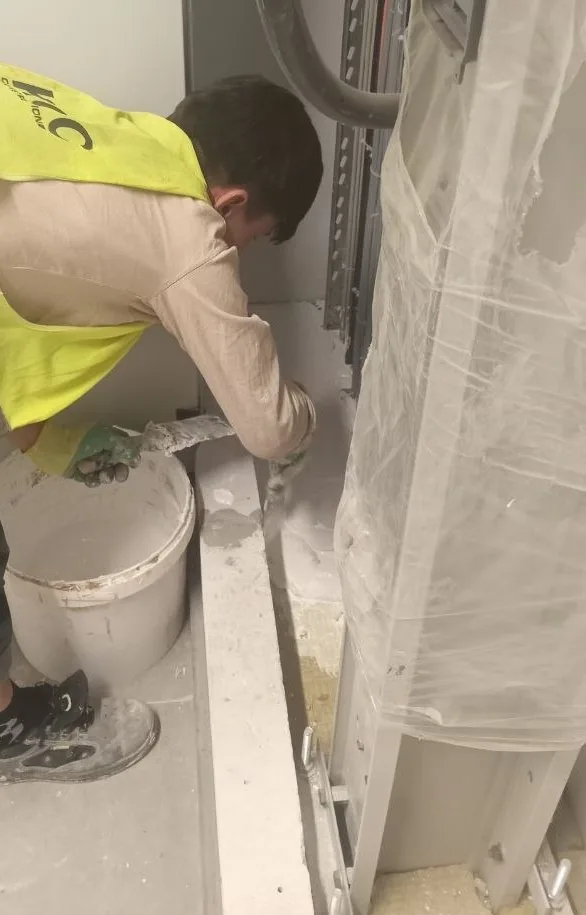
- Application. The sealant is applied with a caulking gun, filling the joint without voids, and tooled to ensure firm contact with both edges.
- Curing. The compound is given time to develop its properties; during this period the joint is protected from mechanical impact and contamination.
Exact parameters (consumption, fill depth, curing time) are taken from the technical information for the specific material — we provide it for your facility.
Regular inspection
Fire protection of penetrations and joints is not a “fit and forget” task. During the building’s service life junctions are opened to run new cables, the structure moves, and the coating can be damaged. The sealing is therefore inspected periodically and restored where needed. What to look at during inspection:
- Cracks, delamination, shrinkage or loss of sealant in the joint.
- Unsealed gaps after cables or pipes have been added or replaced.
- Mechanical damage and signs of moisture exposure.
- Integrity of the adjacent elements of the junction — sealing compound, block, cable protection.
Any defects found are repaired with the same type of material, restoring the continuity of the fill and the fire-resistance limit of the junction.
STABITERM material
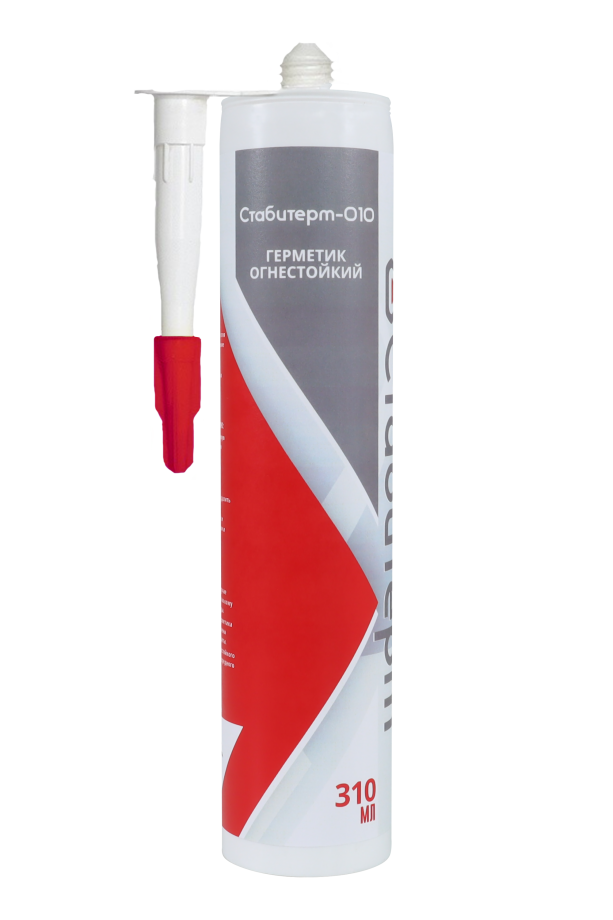
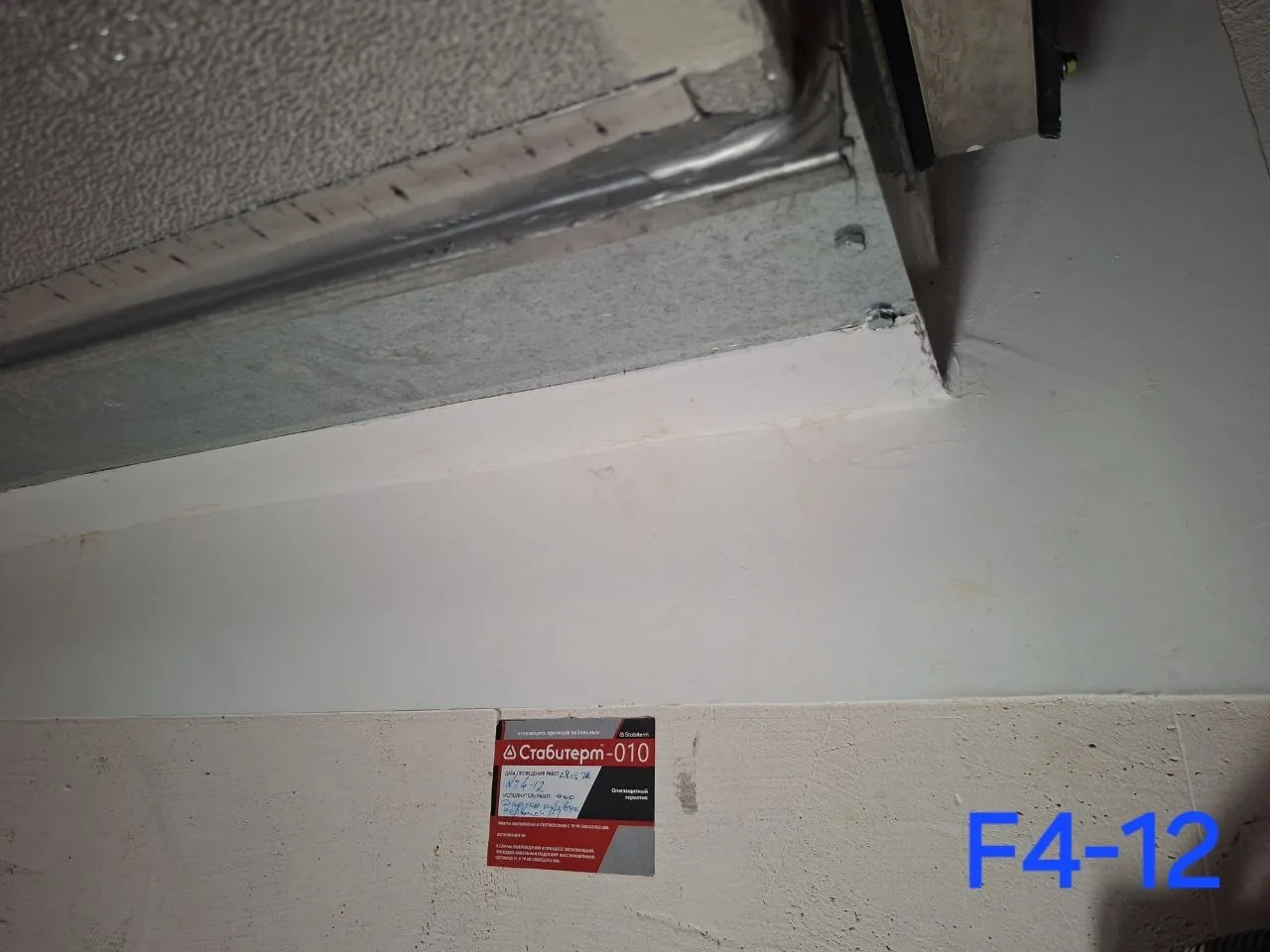
For sealing penetrations, joints and seams, the STABITERM 010 fire-resistant sealant is used: elastic, applied with a caulking gun, impermeable to smoke and gas, lasting for decades. For volumetric filling of large junctions it is combined with the STABITERM 008 sealing compound and the STABITERM 021 fire barrier block.
Examples

Why STABITERM
- Complete range of materials for the fire protection of penetrations and joints in one place.
- Materials in stock in Tashkent, next-day delivery to cities across the republic.
- Many years of use on facilities in Uzbekistan — proven effectiveness and long service life.
- Valid certificates and test reports from the Ministry of Emergency Situations of the Republic of Uzbekistan.
- Solution selection per junction, consumption calculation and a technical information package.
Need a fire-resistant sealant or a penetration solution at your facility? Leave a request — we will select the materials and calculate consumption →
More about the service: Fire-resistant sealant in Tashkent and Uzbekistan →